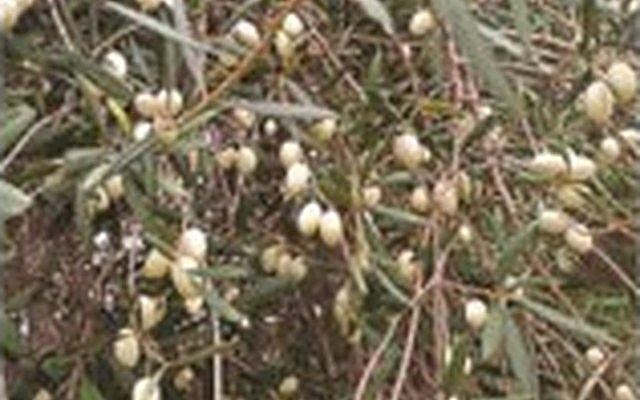
A rare Maltese olive with white ripe fruit, rediscovered in 2010 in a former Knights' garden.
The Maltese white olive, known locally as Bajda ("white") and sometimes sold as Perla Maltese ("Maltese pearl"), is a rare heritage variety of the cultivated olive, Olea europaea. Its ripe fruit is white to cream instead of black, with a fairly sweet flesh, and it is grown mainly as a table olive. It is a local variety, not a separate wild species, and genetic studies class it as a distinct Maltese olive type.
Nearly lost, then found again
The white olive probably came to Malta from southern or central Italy, perhaps in the Renaissance, and may first have been grown as an ornamental tree. Once prized, it had almost disappeared by the late twentieth century. In 2010 a few surviving trees were rediscovered in a former garden of the Knights, and growers have since been propagating it. It is still rare: one report counted only about 70 productive white olive trees in Malta.
Malta's olives
Bajda: pale white ripe fruit, a sweet table olive.
Bidni: an ancient, distinctive Maltese variety prized for its oil.
Malti: a widespread, productive local variety that copes well with drought and heat.
Wild olive (żebbuġ selvaġġ, Olea europaea subsp. oleaster): the native shrubby wild form, with smaller leaves and fruit. It is protected, so do not confuse it with the cultivated varieties.
Growing one
Bajda suits Malta's climate but is not a common garden-centre tree. Look for certified local olive growers or conservation growers who specifically offer Bajda or Perla Maltese stock.
Sources: The ancient olive trees of the Maltese Islands (PMC, 2023); AramcoWorld, "The White Olives of Malta" (2017); Times of Malta; TVMnews; MDPI Sustainability (2022).
Threats
Very few trees left; easily confused with, or replaced by, other varieties.
How to help
Plant Bajda from certified local stock, and leave wild olive trees alone: they are protected.
Photo: Passeri et al. 2023 (detail of Figure 1), CC BY 4.0.