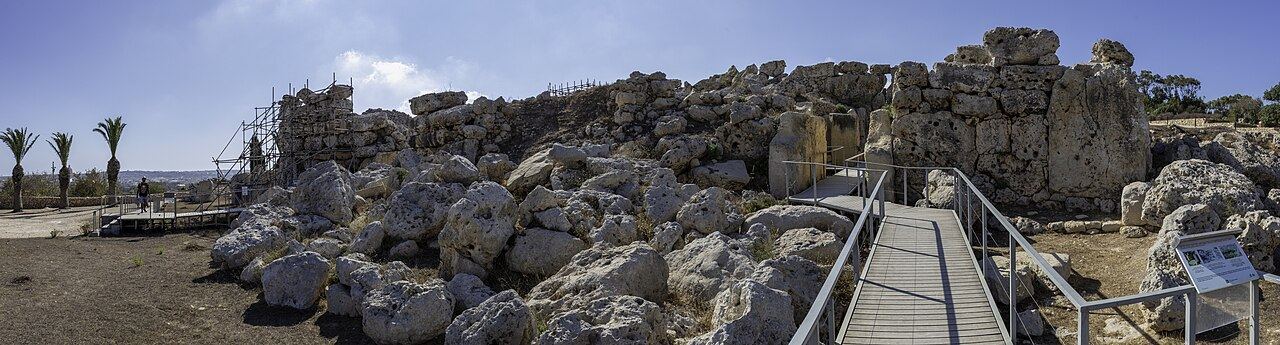
Farmers who reached Malta from Sicily raised megalithic temples older than Stonehenge and the pyramids of Giza.
Key dates
Between approximately 3600 and 2500 BC, Malta saw the flourishing of a remarkable megalithic culture whose achievements rival and in some cases predate the great monuments of ancient Egypt and Mesopotamia. Ġgantija is older than Stonehenge and the pyramids of Giza, and the temples are among the oldest free-standing monuments in the world.
The first farmers
The first settlers sailed to Malta from Sicily around 5900 BC, bringing crops, sheep, goats and pottery. Over the following two thousand years a farming society grew up on the islands. From around 3600 BC its people began constructing elaborate stone temples, and over more than a millennium they built at least seven major temple complexes without metal tools, the wheel or the help of draught animals.
Major sites
Ġgantija (Gozo). On the Xagħra plateau, two temples with separate entrances stand inside a shared outer wall of huge coralline limestone blocks. Heritage Malta places the site in the Late Neolithic, within a wide span of about 3800 to 2000 BC, while the main building is usually dated to about 3600–3200 BC. Plaster fragments with red ochre show that the inner walls were once painted. The name means "giant's tower": Gozitan tradition says a giantess built it.
Ħaġar Qim and Mnajdra. Two temple complexes on the south coast near Qrendi, more than 5,000 years old and about 500 metres apart, probably used by the same community. At Mnajdra the rising sun lines up with the doorways and stones of the south temple at the solstices and equinoxes, which suggests the builders watched the sky closely.
Tarxien Temples. A complex of four megalithic structures in the central plain, built in the Late Neolithic. The south temple is the most richly decorated, with bas-reliefs of spirals and domestic animals. After about 2000 BC, newcomers of the Early Bronze Age turned parts of the site into a cremation cemetery. It was found in 1913 and excavated from 1915 to 1919 under Sir Themistocles Zammit.
Ta' Ħaġrat. In the countryside at Mġarr, in the north-west of Malta: two buildings of local limestone, a larger, older one with a curved façade and a monumental doorway, and a smaller one with a similar plan. Found in 1917, it shows that monumental building was not limited to the coast.
Skorba. Near Żebbiegħ. It is not as spectacular to look at, but it matters to researchers: traces of the earliest farming villages beneath the temples help document the first stages of settlement and temple building.
Building styles. Most temples share a plan of rounded chambers, called apses, set around a central passage behind a curved façade. Outer walls are huge blocks of hard coralline limestone, while the softer globigerina limestone inside was carved with spirals, plants and animals.
Below ground: the Ħal Saflieni Hypogeum
Carved downward into solid rock at Paola, this unique underground complex was used as a sanctuary and burial place for many centuries. Its three levels reach about 10 metres below ground. The small clay figure known as the Sleeping Lady was found here. Only a limited number of visitors are admitted each day, so tickets need to be booked well ahead.
UNESCO recognition
Ġgantija was inscribed as a UNESCO World Heritage Site in 1980, and five more temples (Ta' Ħaġrat, Skorba, Ħaġar Qim, Mnajdra and Tarxien) were added in 1992. The Ħal Saflieni Hypogeum has its own UNESCO listing, also from 1980. They are recognised as outstanding examples of prehistoric religious architecture.
Decline
Around 2500 BC the temple culture came to an end. The reasons (climate change, resource depletion or the arrival of new peoples) remain debated by archaeologists. Bronze Age settlers who arrived afterwards cremated their dead at Tarxien, and the temples fell out of use.
Visiting
The temples are cared for by Heritage Malta. Check opening hours and prices on its website before you go.
Protecting the temples today
Malta's prehistoric temples are not only archaeological attractions; they are part of a living national inheritance. Heritage Malta looks after and explains the sites, and UNESCO listing places a duty on Malta to conserve them for future generations. Protecting them takes conservation, responsible tourism, research, education and respect for the landscapes and communities around them. The people who protect Malta's heritage today carry on a responsibility that began with the communities who first built these remarkable monuments.
Watch
Megalithic Malta: The Best Preserved Temples of Ħaġar Qim and Mnajdra
Ancient Sites Girl
A visual documentary about two of Malta's best-known prehistoric temple complexes and their Neolithic context.
Watch on YouTube ↗More videos
- The Mystery of the Maltese Hypogeum ↗ · Forbidden MysteriesAn episode of the Forbidden History series on the Ħal Saflieni Hypogeum, the underground burial site carved out from about 4000 BC. It explores popular mysteries as well as the archaeology.
- Ġgantija Temples ↗ · Heritage MaltaThe prehistoric temples of Gozo and the megalithic culture that built them, from the body that looks after the site.
- The Temples of Neolithic Malta: Current Interpretations and New Data ↗ · The Ulster Archaeological SocietyA longer academic lecture on how the temples were used, ritual interpretation, the surrounding landscapes and current archaeological ideas.
These videos are on YouTube. Nothing is loaded from YouTube until you press play. Videos are in English.
Photo: Diego Delso, CC BY-SA 4.0. All photo credits